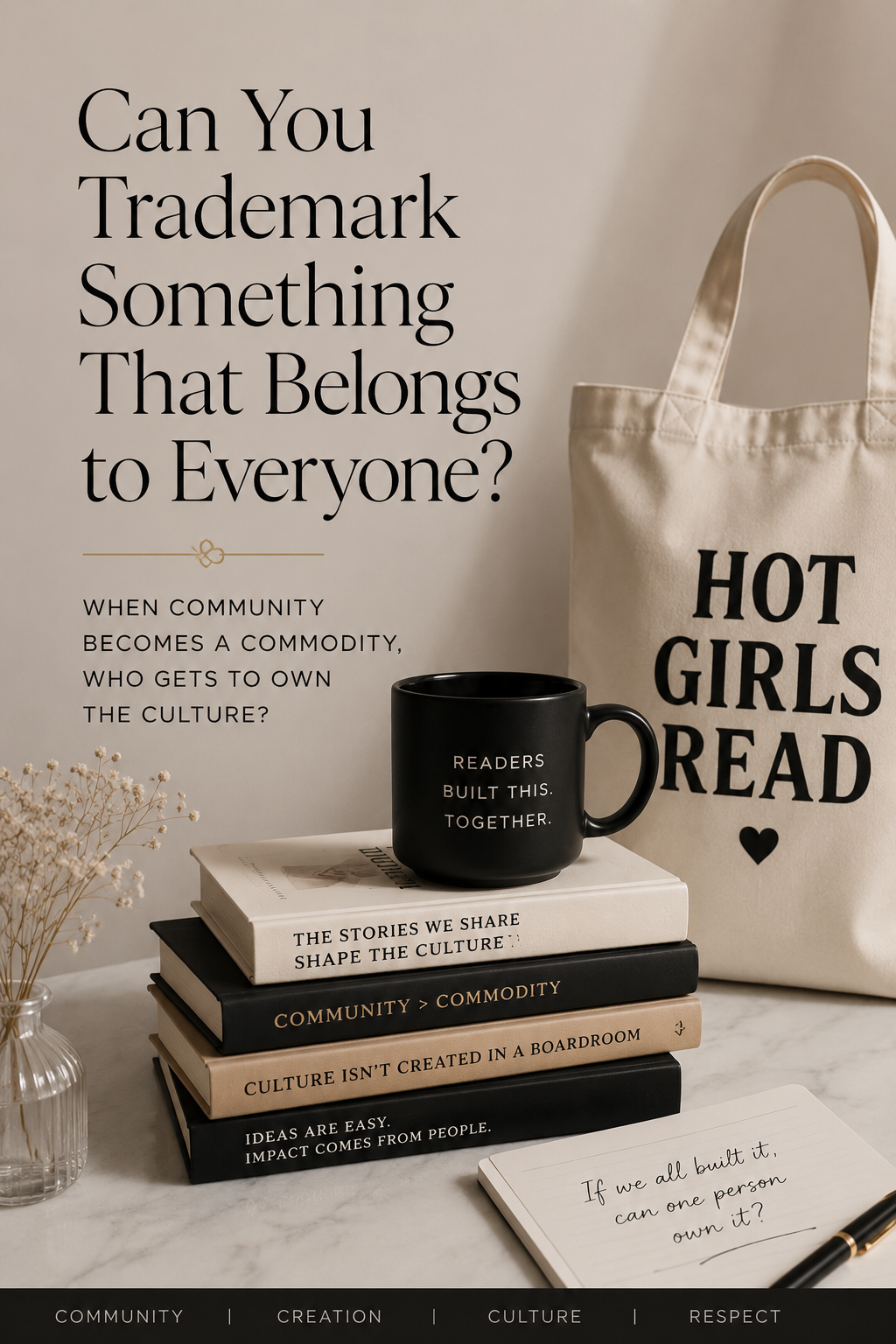
Can You Trademark Something That Belongs to Everyone?
Every once in a while, the internet finds a topic that gets people surprisingly fired up.
This week, it's a trademark.
More specifically, a creator attempting to trademark the phrase "Hot Girls Read."
Now before anyone starts drafting legal arguments in the comments, let me be clear:
This isn't about whether it's legally allowed.
That's a conversation for attorneys.
What interests me is something else entirely.
The reaction.
Because people aren't reacting like someone invented a brand-new phrase and decided to protect it.
They're reacting like someone walked into a community gathering, pointed at the buffet, and said, "Actually, I own this now."
And that's where things get interesting.
Some Things Feel Bigger Than One Person
Whether you've heard the phrase "Hot Girls Read" online, seen it on social media, found it on a tote bag, or heard it mentioned in a book club, the reason it became popular is because people connected with it.
Not one person.
Thousands of people.
Readers adopted it. Book creators used it. Bookstores leaned into it. Entire communities built content around it.
Over time, it stopped feeling like a slogan and started feeling like part of the culture.
And when something reaches that point, people begin to feel a sense of ownership.
Not legal ownership.
Community ownership.
There's a difference.
The Internet Changed the Way Culture Is Created
Years ago, brands mostly told people what to like.
Today, communities decide.
A phrase catches on.
People share it.
Creators build content around it.
Businesses make products inspired by it.
The idea spreads because people collectively decide it has value.
That's why situations like this create such strong reactions.
Because people start asking a simple question:
Who made this valuable in the first place?
Was it one person?
Or was it everyone?
The Small Creator Problem
And honestly, this is where public opinion usually shifts.
Most people understand wanting to protect a business.
What they struggle with is watching smaller creators get caught in the crossfire.
Especially when those creators were already using a phrase that felt publicly shared.
Suddenly the conversation isn't about protecting a brand anymore.
It's about enforcement.
And whether that's fair or unfair isn't even the first thing people focus on.
They focus on how it feels.
And it feels different when the people receiving those messages are independent creators instead of giant corporations.
Just Because You Can Doesn't Mean You Should
This is the question I keep coming back to.
Not the legal question.
The bigger question.
Just because something can be trademarked, does that automatically mean it should be?
Because business decisions don't happen in a vacuum.
Every decision has consequences beyond the paperwork.
You might gain ownership.
You might gain exclusivity.
But you might also lose goodwill.
And goodwill is often what made something valuable in the first place.
The Difference Between Building a Brand and Building a Community
This is where I think people get confused.
A brand belongs to someone.
A community belongs to its members.
Sometimes those two things overlap beautifully.
Sometimes they collide.
The moment people feel like something they helped build is being taken away from them, resistance usually follows.
Not because they're against business.
Not because they're against success.
But because they're against feeling excluded from something they thought belonged to everyone.
Why This Conversation Matters
The reality is that we're going to see more situations like this.
More creators.
More businesses.
More attempts to monetize ideas that started as shared cultural experiences.
And every time it happens, people will ask the same question:
When does something stop belonging to the community and start belonging to a company?
It's a fascinating question because there isn't always a clear answer.
The Real Lesson
What fascinates me most about this entire situation isn't the trademark itself.
It's how strongly people reacted.
Because that reaction reveals something important.
People don't just support brands anymore.
They participate in them.
They contribute to them.
They help create them.
And when they feel like their contribution is being overlooked, they push back.
Maybe that's what this debate is really about.
Not ownership.
Not trademarks.
Not legal rights.
But the growing tension between community and commerce.
And honestly?
I think we're going to be having that conversation a lot more in the future.